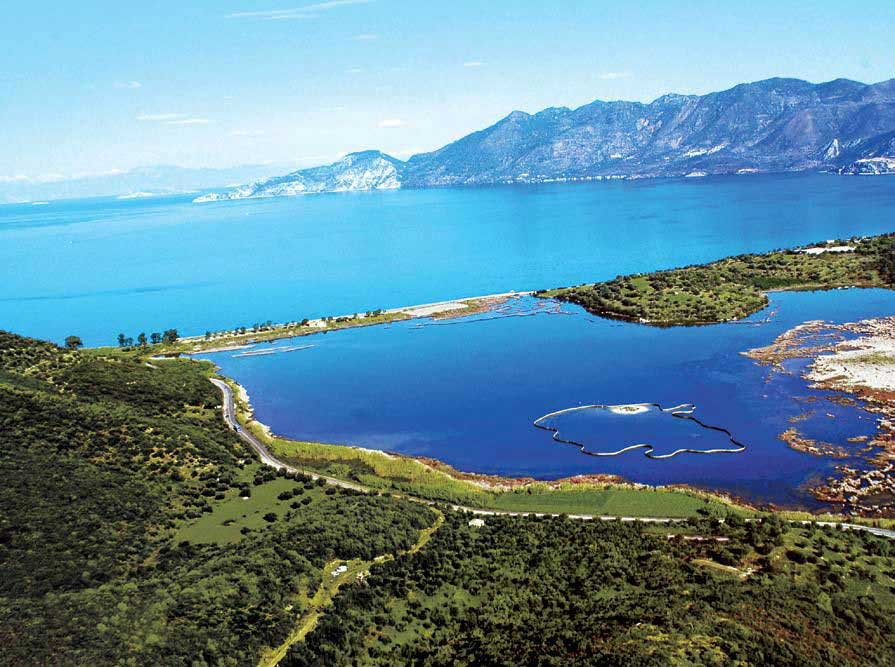
WHAT A FASCINATING PICTURE ...

... viewing the Strait of Poros surrounded by pine, olive, orange and lemon trees. The beauty of the area has been appreciated and praised by prominent writers, poets and artists. Nobel winners such as George Seferis, Kosmas Politis, Kostis Palamas, Julia Dragoumi and the distinguished American writer Henry Miller are some of the island’s admirers.
Many of the houses of Poros are samples of neoclassicism. The Deimezi building, made out of gray and red stone, the shop of Grivas, with wide doors and a beautiful interior décor and several others. Villa Galini, though, is considered one of the finest constructions of Poros, built in 1892, which has accommodated famous Art and Literature personalities.
One of the biggest attractions are the neighborhoods of Poros. Tourists and visitors wander among the narrow alleyways of Poros and the white-washed two-story homes in Brinia, Mylos, Punta and Kastelli, full of bougainvillea.
Ascending, after the square of the Town Hall, the picturesque white paves, we reach the small Church of Saint George with small taverns and shops around it. You will be thrilled by the large Platanus that exists in the tavern Platanos, it is 200 years old.
The Archaeological Museum of Poros, located in Korizi Square is open to the public daily from 9.00 to 15.00 except Mondays. Here you will see findings dated from the Mycenaean to the Roman era that arose from the excavations of the Temple of Poseidon, Ancient Trizina, the Royal Tombs of Magoulas and Apatheia, from Modi and St Konstantinos of Methana. One can even see the magnificent frescoes made by Parthenis in the Cathedral of St. George and visit the Hatzopouleio Public Library.
The conference room of the City of Poros is situated in a historical landmark building designed by a famous German architect, Ernest Chiller. The neoclassical building,renovated in 2002, has a unique artistic quality in detail and can host major conferences for the city, various committees and other private organizations.
The Monastery of Zoodohos Pygi (18th century), built on a green hillside overlooking the sea, is an example of the island’s convent architecture. It combines tranquility with simplicity and picturesqueness. At the monastery’s entrance there is a fountain which is famous for its healing properties. It was named after the side of a stream, beneath towering trees, over the sea. Founded and built by the Bishop of Athens Jacob II at his own expense along with contributions offered by various residents of Poros.
The church has a basilica style with a dome. It’s interior is very impressive with the wooden carved alter (made in Cappadocia, Asia Minor around the 17th century) as well as the Episcopal throne.
The ruins of the Russian Naval Base are found 5 kilometers to the north In 1834, warehouses and bakeries were set up there to refuel and replenish the Russian fleet with supplies while they were sailing in the Aegean Sea. The Russians kept the property until 1900. Since 1989, by decree, the Russian Naval Base was declared a historical landmark, because of its great architectural and historical interest.
Across the Russian Naval Base there is the small island "Daskalio" with its small picturesque Church of the Virgin Mary, on a beautiful cove.
Following the spiral road covered by large pine trees, we arrive at the Chapel of Our Lady of Agia Zoni, which is celebrated on July 2nd. Located between a gorge with lush plane trees and running water. It is one of the most beautiful spots in Poros where many marriages and baptisms take place.
The Diavologefyro is a steep area of wild beauty. located right after the village of Trizina. It's a beautiful cliff with lush plants, full of oleanders, plane and old trees . In the background you will see a small river running The water falls from the mountains creating small lakes in some parts and surrounded by huge rocks. The gorge has walking access , abundant plant life, no trace of civilization and includes many activities like water slides, jumping, etc. Amazingly, there is running water even during summer.
The Lemon Grove (Lemonodasos) is a big area full of lemon trees with lots of water and water mills. From the top, the view is panoramic It is basically a forest of over 30,000 lemon and orange trees with scattered taverns all around. Green lemon and orange trees that smell delightfully and provide the perfect setting for romantic strolls.
Situated east of the port is the islet of Bourtzi with its small castle, built in 1827 by the Bavarian philhellene K.Eintek to protect the harbor. Located on the cove of the monastery near the Peloponnesian coast where anyone can swim to visit it. The castle helped the people of Poros detect ships coming from Hydra. Today it is uninhabited.
MORE PHOTOS
|